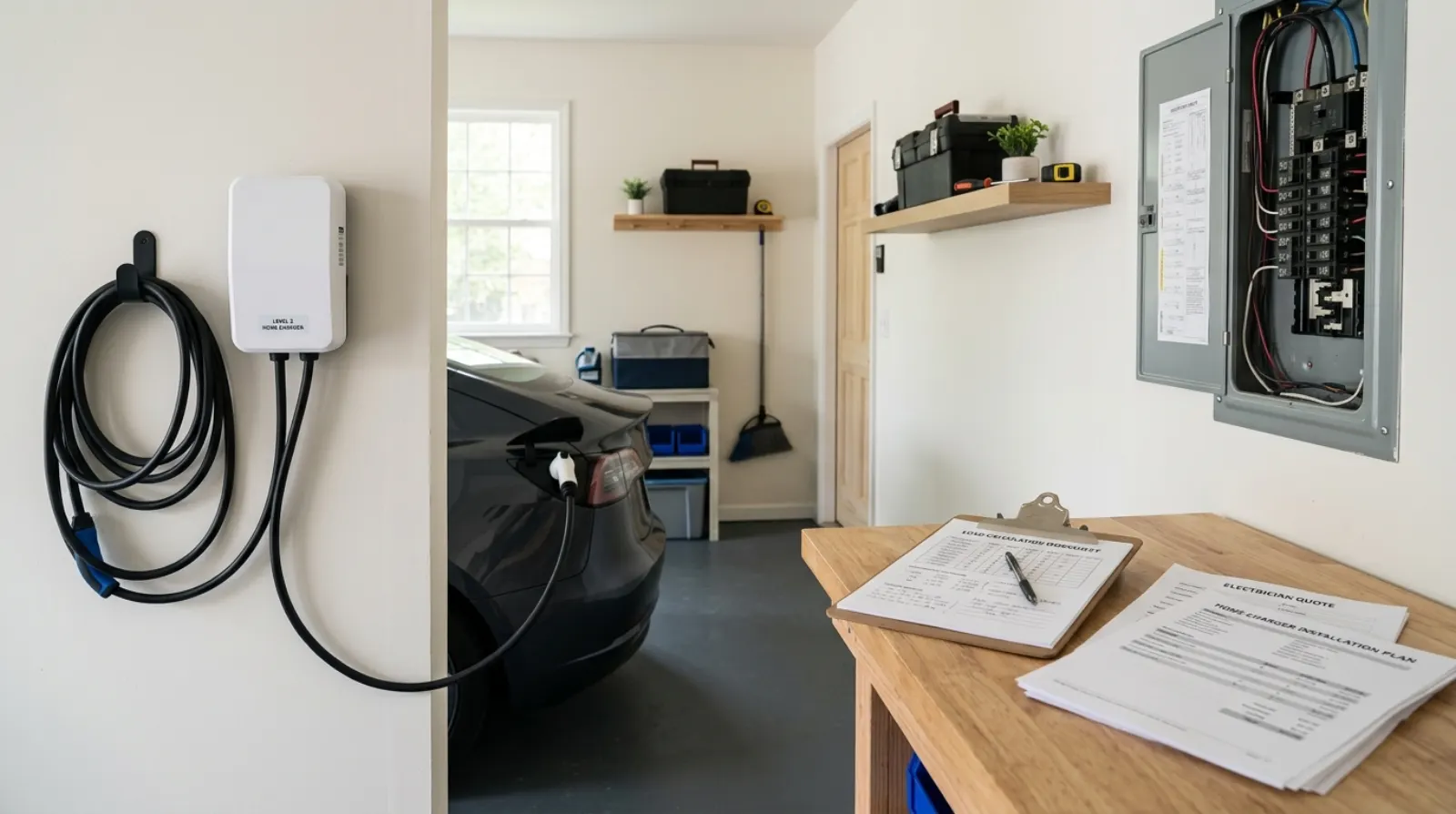
EV Charger Buying Guide 2026: The Whole Project, In Order
The full home EV charger decision path: Level 1 vs Level 2, amperage, hardwired vs plug-in, panel capacity, installed cost, and NACS vs J1772.
Final Decision
Quick answer: Decide in this order: whether you need Level 2 at all, what amperage your driving actually requires, hardwired or plug-in, whether your panel can take the circuit, and only then which charger. The box is $300 to $800 in 2026. The install is $500 to $1,500 near the panel and $1,500 to $4,000 or more with a long run or a panel upgrade. Buy a charger that handles both NACS and J1772, or pick the connector for the car you will own in five years, not the one in the driveway today.
Best for
New and soon-to-be EV owners who want the whole home charging decision handled correctly, once.
Wrong fit
DC fast charging, commercial or fleet projects, or anyone looking for DIY 240V wiring instructions. Installs are licensed-electrician work.
Tradeoff
Every dollar you spend on charger features moves the project less than the questions nobody asks first: your daily miles, your panel, and the length of the circuit run.
The charger is the cheap part. That one sentence saves more money than any product review on the internet.
A good Level 2 home charger is a $300 to $800 box in 2026. The install is where the project is decided: $500 to $1,500 all in when the run is short and the panel has room, $1,500 to $4,000 or more when it does not. Most buyers research the box for two weeks and the install for zero minutes, then meet the real project on the electrician's invoice.
This guide walks the whole decision in the right order. Work it top to bottom and the invoice holds no surprises.
The decision path
Step
Question
Wrong-order cost
1
Do I need Level 2 at all?
$1,000+ project you could have skipped
2
What amperage do my miles need?
A panel upgrade you did not need
3
Hardwired or plug-in?
A melted bargain outlet
4
Can my panel take it?
The $2,000 to $4,000 surprise
5
What does it cost installed?
Quote shock, or overpaying by half
6
NACS or J1772?
A charger that is obsolete for your next car
7
Smart or dumb?
Paying for features the car already has
8
Which charger?
The only step the ads talk about
1. Do you need Level 2 at all?
Honest answer first: maybe not.
The 120V cord that came with the car adds roughly 3 to 5 miles of range per hour. Plugged in from 7 pm to 7 am, that is 40 to 60 miles replaced every night. If you drive less than that, Level 1 covers you and you can skip this entire project. No electrician, no permit, no panel question.
Level 2 earns its cost when you drive more than about 40 miles a day, cannot plug in every night, have two EVs, or heat the battery through cold winters. The full math is in do I need Level 2 charging.
We don't sell chargers. If Level 1 covers your miles, that is the answer.
2. Amperage: bigger is often wrong
Level 2 chargers commonly come in 32A, 40A, and 48A. The sales logic says buy the biggest. The electrical logic says the opposite.
EV charging is a continuous load, so the National Electrical Code sizes the circuit at 125 percent of the charger's output. A 32A charger needs a 40A breaker. A 40A charger needs a 50A breaker. A 48A charger needs a 60A breaker and thicker, more expensive wire, and it must be hardwired. Every step up means more copper, and sometimes it is the step that tips your panel into an upgrade.
Here is the number that matters: a 32A charger adds about 25 miles of range per hour. Overnight, that is 200+ miles. Almost every commuter is full by morning on 32A. The cases where 48A actually pays are covered in the amperage guide.
Buy the amperage your driving needs and your panel can carry. Not the biggest number on the shelf.
3. Hardwired or plug-in
Plug-in units connect to a NEMA 14-50 outlet. Flexible, and often cheaper if a proper outlet already exists. Two catches. First, a 14-50 outlet installed to code with the GFCI breaker the NEC requires for EV use runs $500 to $1,200 installed, not the $15 the receptacle costs. Second, cheap residential-grade outlets have melted under continuous EV load. If you go plug-in, the outlet must be an industrial-grade receptacle on a GFCI breaker, full stop. The failure mode is documented in NEMA 14-50 outlet safety.
Hardwired costs a little more in labor, skips the outlet and its GFCI nuisance-trip issues, is required for 48A charging, and is the cleaner permanent install for most garages.
Rule of thumb: plug-in makes sense when a code-correct outlet already exists or you genuinely expect to move. Otherwise hardwire it. The full comparison is in hardwired vs plug-in.
4. The panel question, before the electrician arrives
This is the single biggest invoice surprise: the $2,000 to $4,000 panel or service upgrade.
A licensed electrician runs a load calculation under NEC Article 220 to check whether your existing service can carry a new continuous load. On a 200A panel with normal loads, a 40A or 48A circuit usually fits. On a 100A service, or a panel already feeding an AC, a range, and a dryer, it often does not.
Two things to know before anyone quotes you:
You can screen this yourself. Find your main breaker rating and count the big loads. Do I need a panel upgrade walks through it in ten minutes.
A full panel upgrade is often avoidable. Dropping from 48A to 32A, or using a charger with built-in load management that throttles when the house is busy, keeps many homes off the upgrade entirely. That option is exactly what nobody selling the upgrade mentions. Details in the load management guide.
An honest installer asks about your panel before giving you a number. One who quotes a panel upgrade without showing a load calc is guessing with your money.
5. What it actually costs installed, 2026
Setup
Real all-in
Short run, panel has capacity
$500 to $1,500
Plug-in with new code-correct 14-50 outlet
$850 to $2,000
Long run or detached garage
$1,600 to $4,000+
Job that forces a panel or service upgrade
$2,500 to $4,800+
All figures include a $300 to $800 charger, 2026 pricing. The three levers are the distance from panel to parking spot, plug-in versus hardwired, and the panel verdict. The line-item breakdown lives in the real cost guide, and the cost calculator turns your own panel, run length, and daily miles into a range.
Get two or three quotes. The same job routinely comes back $900 from one electrician and $4,000 from another, and the spread is rarely about quality. Permits are real, by the way: a few hundred dollars, an inspection, and the paper trail that protects your insurance and your home sale. Skipping the permit is how uninspected 240V work catches fire or surfaces during closing. The details are in the permit guide.
6. NACS vs J1772: do not buy your next car a problem
Two connectors are in play. J1772 is the legacy Level 2 standard most non-Tesla EVs still carry. NACS, standardized as SAE J3400, is what essentially every major automaker has committed to, with built-in NACS ports arriving model by model through 2026 and beyond.
For home charging this is less scary than it sounds. Level 2 adapters between the two are cheap and work fine. But if you are buying a charger to keep for ten years, the clean answers are:
A dual-connector or universal unit (the Tesla Universal Wall Connector carries both).
Or match the connector to the car you expect to own in five years, and budget a $50 to $200 adapter for the transition.
What you should not do is pay a premium for a J1772-only unit out of habit, or panic-replace a working charger. The full picture, including the adapter rules, is in NACS vs J1772.
7. Smart or dumb
A smart charger gives you an app, scheduling, energy tracking, and sometimes utility-program participation. Two honest caveats before you pay for it.
First, your car already schedules its own charging. If all you want is overnight off-peak charging on a time-of-use rate, the car's built-in scheduler does it with a dumb charger.
Second, app-dependent chargers carry a real risk the spec sheet never mentions: when Enel X shut down its North American operation in October 2024, JuiceBox owners lost app features on hardware that still worked. A charger that needs a cloud service to be smart is a bet on that company's survival.
Smart features earn their cost when your utility pays you for them (managed-charging rebates and TOU enrollment sometimes require a connected charger) or when you need load management to dodge a panel upgrade. Otherwise the $150 premium buys a dashboard. The breakdown is in smart vs dumb chargers.
8. The condo and HOA route
If you park in a shared garage or deeded spot, the project changes shape: approvals before electricians, metering questions, and sometimes right-to-charge laws that force the HOA's hand. California, Colorado, Florida, and a growing list of states have them. Start with the condo and HOA guide before you buy any hardware, because the building decides what is possible, not the charger brand.
Rebates in 2026: check the date on every claim
The federal 30C credit, which covered 30 percent of home charger hardware and install up to $1,000, is gone for new installs. IRS guidance under the July 2025 tax law is explicit: the Section 30C alternative fuel refueling property credit is not allowed for property placed in service after June 30, 2026. If your charger went in on or before that date, you can still claim it on your return with Form 8911. A 2026 quote that subtracts a federal charger credit for a new install is using stale math.
Utility and state money is still real: charger rebates, panel-upgrade support, and time-of-use enrollment bonuses vary by territory. Check the tax credit reality and rebates by state, and confirm any claim with a dated source before it changes which quote you sign.
Now, and only now: the charger
If you worked the steps above, the shortlist almost picks itself, because you now know your amperage, connector, hardwired-or-plug-in answer, and whether load management matters. Five units cover almost every buyer in 2026, ranked honestly in best home EV chargers, with the budget picks in best budget chargers and the full field in the brand directory.
One warning that outranks any ranking: skip the unbranded Amazon units with inflated amperage claims and no UL or ETL listing. A "50A plug-in" with no safety listing is not a bargain. It is a fire path with free shipping.
The mistakes, compressed
Buying the charger before checking the panel.
Paying for 48A when 32A fills the car every night.
A cheap 14-50 outlet on a non-GFCI breaker.
A J1772-only premium charger two years before your NACS car arrives.
Trusting a federal credit line dated before July 2026.
For a lot of drivers, yes. Level 1 replaces 40 to 60 miles overnight. If your daily driving sits under that and you can plug in most nights, you do not need this project. Level 2 is for higher mileage, two-EV households, cold climates, and anyone who cannot charge every night.
What amperage should I buy for my car and panel?
Start from your daily miles, not the car's maximum. 32A restores 200+ miles overnight and fits more panels without an upgrade. Go 48A only when your driving, your car's onboard charger, and your panel all justify it. When the load calc is tight, load management beats a panel upgrade on price.
How do I know if my panel can take it before the electrician shows up?
Read your main breaker rating and list your big 240V loads. 200A service with normal loads usually fits a Level 2 circuit. 100A service with electric heat, range, and dryer usually means load management, lower amperage, or an upgrade. A licensed electrician confirms with an NEC 220 load calculation. Never let anyone sell you an upgrade without one.
Does the NACS switch make today's chargers a mistake to buy?
No. Level 2 adapters between NACS and J1772 are inexpensive and safe for AC charging. Buy a dual-connector unit if you want zero friction, or buy for your next car and use an adapter in the meantime. The only real mistake is overpaying for hardware that fits neither of your next two cars.
Do smart features actually save money on time-of-use rates?
Only if your utility pays for them or your car cannot schedule its own charging. The TOU savings come from charging off-peak, and the car's scheduler does that for free. A connected charger earns its premium when it unlocks a utility rebate or managed-charging credit, or when its load management avoids a panel upgrade.
These guides are built from manufacturer documentation, public specifications, primary research where safety claims matter, and repeated buyer questions that show up in real ownership and installation decisions.
Manufacturer responses can clarify pricing bands, warranty terms, support footprint, or common mistakes. They do not move a page up the shortlist on their own.