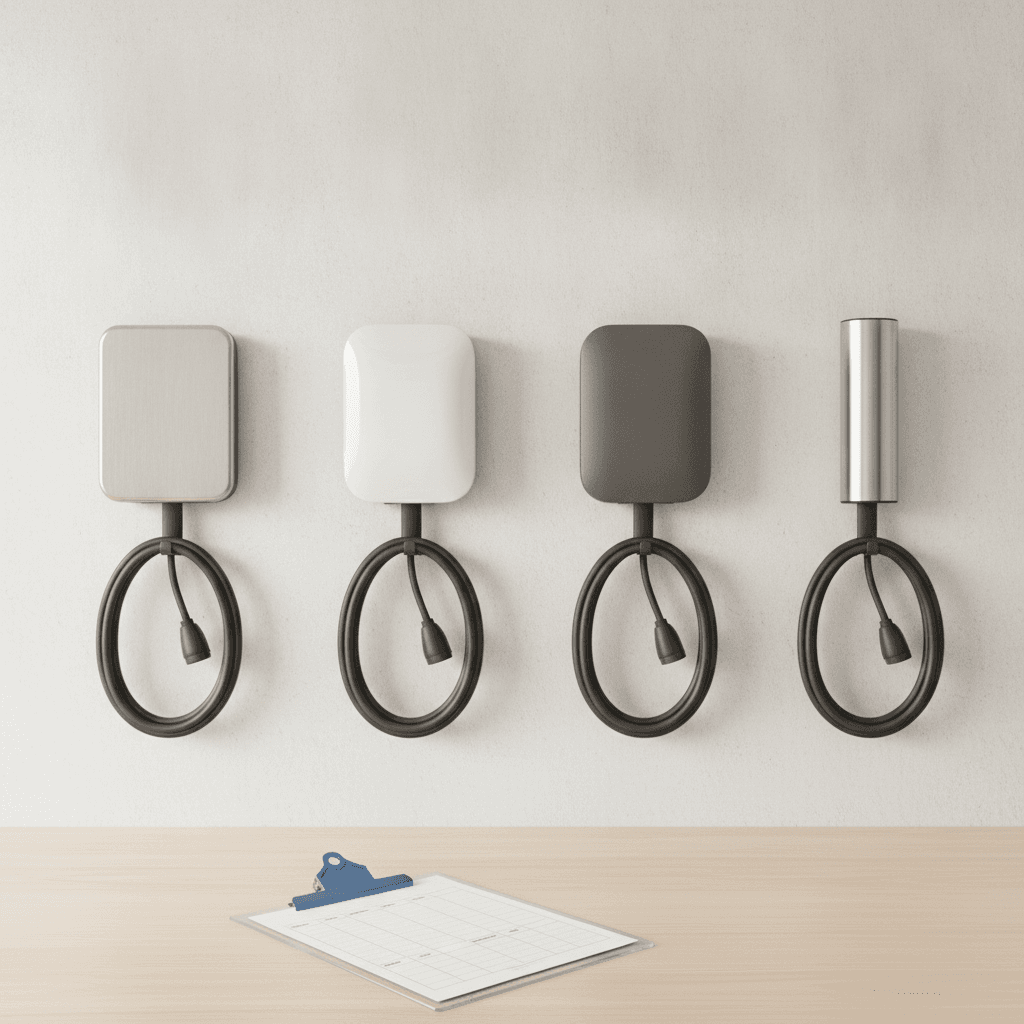
Five Level 2 chargers worth buying, from the $600 Tesla Universal to the $300 Grizzl-E, with the real installed cost and each unit's weak spot.
Shortlist
Quick answer: Five Level 2 home chargers cover almost every buyer in 2026. Tesla Universal ($600) is the best all-around hardwired 48A unit with NACS and a built-in J1772 adapter. Emporia Classic ($449) is the value smart pick, while the $599 Pro adds Vue 3 load management. ChargePoint Home Flex ($494-$539 sale) is the flexible J1772-or-NACS, plug-in-or-hardwired pick. Grizzl-E Classic ($299.99 sale) is the rugged no-app default. Wallbox Pulsar Plus ($649.99 flat) is the compact premium option.
Best for
Buyers who have decided on Level 2 and want a short, credible list with the real installed cost and each charger's actual weak spot.
Wrong fit
Low-mileage drivers who may be fine on Level 1, and buyers who have not yet checked whether their panel can take a full-amperage circuit.
Tradeoff
The box you pick barely moves the total. The install length and whether your panel needs an upgrade decide the bill, so choose the charger for connector, amperage, and load management, not for app features.
Five Level 2 chargers cover almost every home buyer in 2026, and the honest headline is that the box you pick matters less than most roundups pretend. Any of these is a $300 to $800 charger bolted into a $500 to $4,000 install, and it is the install, not the badge, that decides your bill. So this list ranks on the things that actually differ: connector, amperage, load management, build, and the one real weak spot each unit carries.
We don't sell chargers. We save you from buying the wrong one, and the wrong one here is usually a unit that forces a panel upgrade you did not need, or one whose features you pay for and never use because your car already schedules its own charging. Before you shortlist, make sure Level 2 is even your answer in do I need Level 2 charging, and price the whole job in the real cost of installing an EV charger.
Quick Answer: The Five at a Glance
Charger
Price (2026)
Real installed
Max amps
Connector
Hardwired / plug-in
Safety listing
Load management
Warranty
Smart (WiFi/app)
Notable weakness
Tesla Universal Wall Connector
$600
$750-$2,500+
48A
J1772 + NACS (both)
Hardwired only
cULus, UL 2594 + UL 2231 (file E351001)
Built-in Group Power Management, free, up to 6 units
4 yr
Yes
No plug-in option, so no easy relocation
Emporia
$449 Classic / $599 Pro
$650-$2,500+
48A (40A plug-in)
J1772 or NACS
Both
UL 2594 + UL 2231
Pro bundles the Vue 3 monitor at $599; Classic has none
3 yr
Yes; Pro includes Vue 3
Newer brand than ChargePoint, shorter support track record
ChargePoint Home Flex
$494-$539 sale, $549-$599 list
$750-$2,500+
50A (40A plug-in)
J1772 or NACS
Both
UL 2594 + UL 2231-2
None at any price, not even as an add-on
3 yr
Yes
List price runs premium, and there is no power-sharing option at all
Grizzl-E Classic
$299.99 sale, $379.99 list
$500-$2,300+
40A
J1772
Both
UL/cUL, UL 2594 (file E510712)
None on the Classic; only the separate Classic Connect model adds it
3 yr (5-year add-on)
No (Classic Connect adds it)
No WiFi or scheduling on the Classic, stiff cable in deep cold
Wallbox Pulsar Plus
$649.99 flat (40A or 48A)
$850-$2,600+
48A (40A version)
J1772 or NACS
Both
UL 2594 + UL 2231
Separate Power Meter required, $332.48 (sale)
3 yr
Yes
Company mid a court-approved debt restructuring in 2026
Prices and warranty terms are as published by each maker, Emporia and Wallbox prices checked directly against their own stores on 2026-08-30, Tesla, ChargePoint, and Grizzl-E prices carried over from the last confirmed check because their shop pages blocked automated verification this run, see Sources. Every unit above is UL or cUL listed to UL 2594, the core EVSE safety standard, plus UL 2231 (Grizzl-E's public certification page lists only UL 2594), and that listing is exactly what the no-name Amazon "48A" units skip. Installed ranges assume a short run with panel capacity at the low end and a long run or panel upgrade at the high end.
How We Compared These Five
Six criteria decide this list, in order: safety listing, connector support, amperage ceiling, hardwire-or-plug-in flexibility, load management (and what hardware it actually costs), and warranty. The real installed cost range sits alongside the sticker price in the table above because it is usually the bigger number, but it is a buying input, not a ranking criterion, since it depends on your panel and run length, not the charger. Two things disqualify a charger from this list outright, no matter how cheap or fast it claims to be: no UL or ETL listing at all, and a core function that only works through the maker's cloud app with no offline fallback, the failure mode that left JuiceBox owners with dead features when Enel X Way shut down in October 2024. None of the five above has that problem today.
The Best All-Around: Tesla Universal Wall Connector
If your household is Tesla or mixed-brand and you want a proven hardwired 48A unit at a fair price, the Universal Wall Connector is the easy default. It runs a flat $600 direct from Tesla with no dealer markup (2026), it is built well, and it carries both a J1772 and a NACS connector in one unit, so it is not a connector gamble as the NACS transition plays out. That dual connector is the reason it earns the top all-around spot: you can charge any car in your driveway today and any car you buy next.
The one real caveat is that it is hardwired only. There is no plug-in version, so you cannot unplug it and take it to a new house, and the install is a hardwire job every time. For a buyer who wants the charger handled once, correctly, that is a fine trade. For a renter or someone who moves often, a plug-in unit makes more sense. Its full head-to-head with the other mainstream default is in Tesla vs ChargePoint.
The Smart-Panel Pick: Emporia
If your panel is tight and you want to avoid a service upgrade, the Emporia Pro is the one to look at first. The Classic is $449 and the Pro is $599 direct in July 2026. The Pro bundles the Vue 3 whole-home monitor needed for PowerSmart load management, so charging can respond to the home's total load. That feature can save far more than the $150 step from Classic to Pro when a documented load-management design avoids a service upgrade. Both hardwire at up to 48A or plug in at 40A, and you pick J1772 or NACS at checkout.
The caveats are honest ones. Emporia is a newer brand than ChargePoint, so its app and support have a shorter track record. The $449 Classic alone is not the complete load-management design; make sure the quote names the Pro/Vue hardware and commissioning. Weigh it against a panel upgrade directly in do I need a panel upgrade for an EV charger.
The Flexible Pick: ChargePoint Home Flex
If you want the most established name and the flexibility to plug in now and hardwire later, the ChargePoint Home Flex is the pick. Sale prices at ChargePoint's own store run about $494 hardwired or $539 plug-in (July 2026), against a $549 to $599 list. It installs either plug-in at 40A or hardwired up to 50A, its amperage is adjustable, and the current hardwired buying path offers J1772 or NACS connector choices. The app is mature, which matters if you actually want charging history and scheduling from the charger rather than the car.
The caveats: the $549 to $599 list price sits at the premium end even if the store markdowns look semi-permanent, and some of its convenience features lean on the ChargePoint app and account, so it is a more app-dependent product than a plain hardwired unit. If you value the network and the polish, that is a fair price. If you just want electrons and your car already schedules, a simpler unit saves money, which is the whole point of smart vs dumb EV charger.
The Budget Default: Grizzl-E Classic
If you want a rugged, no-drama unit and the lowest sticker, the Grizzl-E Classic is the budget default at $299.99 on sale, $379.99 list in July 2026. It is a 40A charger in a cast-aluminum case, it plugs into a NEMA 14-50 or hardwires, and it is UL listed. It skips WiFi entirely, and for most buyers that is a feature, not a flaw, because the car already handles scheduling and time-of-use charging on its own. You lose nothing you were going to use.
The honest weak spots: the Classic has no app, no scheduling, and no energy monitoring, so if you specifically want charger-side load management, look at the Emporia or the Grizzl-E Classic Connect model instead. The cable is also stiff in deep cold, a common owner note in northern climates. For a garage in a mild climate on a car that schedules itself, it is the most charger for the money. The full budget field is in best budget EV chargers.
The Compact Pick: Wallbox Pulsar Plus
If space is tight and you want a small, good-looking unit with a full app, the Wallbox Pulsar Plus fits. Direct pricing is now a flat $649.99 for either the 40A plug-in or the 48A hardwired version (August 2026), and Wallbox added its own NACS-connector model in 2026 at the same price, so you no longer have to verify the connector before buying. The app offers scheduling, energy tracking and power sharing across two Wallbox units, which suits a two-EV garage.
The caveats are worth knowing before you buy. Dynamic load management and solar-surplus charging require Wallbox's separate Power Meter, listed at $332.48 on sale ($349.98 regular, checked 2026-08-30), so compare the complete hardware stack with the $599 Emporia Pro. Wallbox is also mid a court-approved debt restructuring in 2026, still selling and warrantying the Pulsar Plus but worth knowing before you bet a 3-year warranty on it. The full breakdown, including the company-status question, is in Emporia vs Wallbox.
How to Pick in One Read
Want it handled once, any car, best all-around? Tesla Universal Wall Connector. The dual connector makes it the safest long-term buy.
Panel is tight and you want to dodge an upgrade? Emporia, for the load management and energy monitoring.
Want the established network and plug-in flexibility? ChargePoint Home Flex.
Want the lowest price and the toughest box? Grizzl-E Classic, and skip the WiFi you were not going to use.
Tight space, want a compact unit with a full app? Wallbox Pulsar Plus.
The two quote details that changed this refresh
First, connector choice is no longer a reason to dismiss ChargePoint: the current Home Flex hardwired path offers J1772 or NACS. Second, load management is not a generic checkbox, and it is not available at all on two of these five. Emporia's value case depends on the $599 Pro/Vue bundle, Wallbox requires a separate $332.48 Power Meter for its comparable dynamic-load and solar-surplus functions, and ChargePoint Home Flex and the Grizzl-E Classic have no path to it whatsoever, at any price. Compare the complete control hardware, or its absence, before a contractor uses "smart charger" as a panel-upgrade substitute.
Whichever you pick, the box is the small decision. Get the amperage right in the EV charger amperage guide so you do not force a panel upgrade, decide hardwired vs plug-in, and price the whole install before you buy. If you are also weighing solar or a home battery, the panel math changes, and homebattery.guide is worth a look before you upsize anything. If a heat pump is next, include that load now using the heat pump electrical-panel guide so you size the service once.
Frequently Asked Questions
What is the best home EV charger to buy in 2026?
For most buyers, the Tesla Universal Wall Connector ($600 direct from Tesla) is the best all-around pick, because it is a proven hardwired 48A unit that carries both J1772 and NACS connectors, so it works with any car today and any car you buy next. If your panel is tight, the Emporia is the smarter buy for its load management. If you want the lowest price, the Grizzl-E Classic (about $300 on sale, $380 list) is the rugged budget default.
Does the brand of charger really matter, or is it all the install?
The install matters more. Any credible Level 2 charger is a $300 to $800 box, and the install runs $500 to $4,000 depending on your run length and whether your panel needs an upgrade. Pick the charger for connector, amperage, and load management, then spend your energy getting the install priced right after a load calc. That is where the real money and the real mistakes are.
Should I get a smart WiFi charger or a plain one?
Only if you will use the smart features. Most modern EVs already schedule their own charging and handle time-of-use rates from the car, so a plain unit like the Grizzl-E Classic covers the basics for less. A smart charger earns its price if you want charger-side load management to avoid a panel upgrade, or genuine energy monitoring, which is where the Emporia stands out. Otherwise you are paying for an app the car makes redundant.
Is the Tesla Universal Wall Connector worth it for a non-Tesla?
Yes, and that is the point of the "Universal" name. It carries both a J1772 and a NACS connector in one unit, so it charges a Ford, a Hyundai, a Rivian, or a Tesla with no adapter juggling. At $600 it is priced with the other mainstream units, and the dual connector makes it the safest long-term buy as the connector standard shifts. The only catch is that it is hardwired only, so there is no plug-in version to relocate.
Are cheap Amazon EV chargers safe?
Be careful. A credible charger is UL or ETL listed, and that listing is exactly what many no-name Amazon units skip while claiming inflated amperage like "48A" or "80A" on a plug-in cord that cannot safely deliver it. The other trap is a cloud-app-dependent unit from a company that can disappear, as JuiceBox owners learned when Enel X Way shut down its North American operations in October 2024 and the app went away. Stick to a UL or ETL listed unit from a maker that will still exist, and read EV charger safety.
What amperage charger do I actually need?
For most drivers, 32A to 40A is plenty. A 32A charger adds roughly 25 to 30 miles of range per hour, which fills the average car overnight, and it runs on a smaller breaker and thinner wire than a 48A unit, sometimes avoiding a panel upgrade. Go to 48A only if you drive high daily miles or have a car and a panel that both support it. Bigger is often the wrong buy, and the full math is in the EV charger amperage guide.
These guides are built from manufacturer documentation, public specifications, primary research where safety claims matter, and repeated buyer questions that show up in real ownership and installation decisions.
Manufacturer responses can clarify pricing bands, warranty terms, support footprint, or common mistakes. They do not move a page up the shortlist on their own.