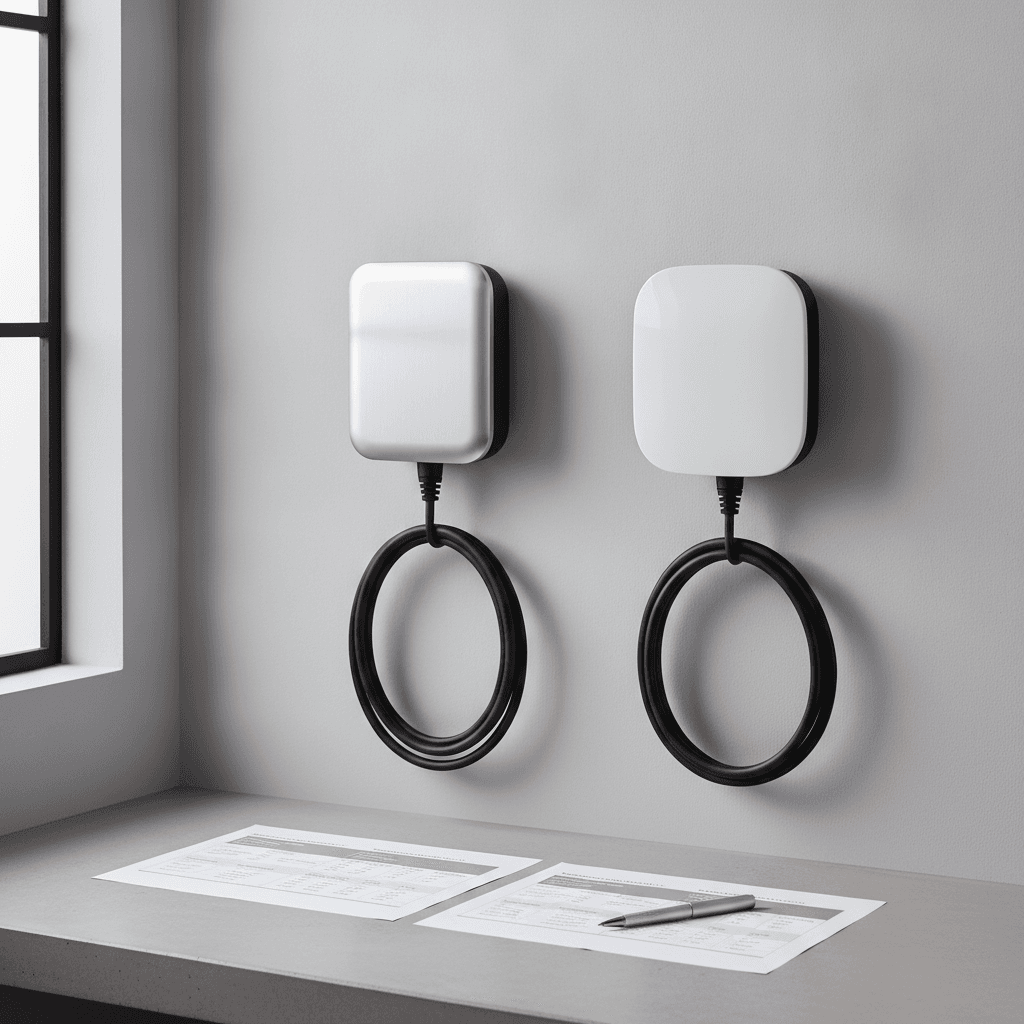
Emporia is $449 with load management built in. Wallbox starts at $649.99, smaller with a better app, but the company is mid-restructuring. The honest pick.
Comparison
Quick answer: Emporia ($449 Classic, $599 Pro) and Wallbox Pulsar Plus ($649.99 for the 40A, $699.99 for the 48A) are both credible Level 2 chargers, and the installed cost is the same either way, because the install sets the bill, not the box. Emporia is the better default for most buyers: it is cheaper, its load management can avoid a panel upgrade, and you pick J1772 or NACS at checkout. Wallbox wins on physical size, the most compact unit here, and now sells its own NACS version too. The one thing worth knowing before you buy: Wallbox is mid a court-approved debt restructuring in 2026, still selling and warrantying the Pulsar Plus, but a fact worth weighing if company continuity matters to your 3-year warranty.
Best for
Buyers who have narrowed it to these two smart Level 2 chargers and want the tradeoffs that actually differ, including the one neither spec sheet tells you.
Wrong fit
Buyers who have not decided on amperage or checked their panel, or who want a dual J1772-and-NACS connector in one unit, where the Tesla Universal Wall Connector is the answer instead.
Tradeoff
Emporia buys you a lower price and load management that can dodge a panel upgrade. Wallbox buys you the smallest footprint and a polished app, from a company currently restructuring its debt.
Emporia and Wallbox Pulsar Plus are both credible Level 2 home chargers, the Emporia Classic at $449 and the Pulsar Plus at $649.99 for the 40A and $699.99 for the 48A, and the installed cost is the same either way, because the install sets the bill, not the box. This is not a good-versus-bad question. It turns on three things: price and load management, physical size, and one company-status fact that no spec sheet volunteers.
We don't sell chargers. We save you from buying the wrong one, and here that means naming the tradeoff plainly: Emporia is the stronger buy for most homes, but Wallbox is a real option if the compact size matters to you, and you should know what you are buying into either way.
Quick Answer: Emporia vs Wallbox at a Glance
Dimension
Emporia
Wallbox Pulsar Plus
Price (Aug 2026)
$449 Classic, $599 Pro
$649.99 for 40A, $699.99 for 48A
Real installed
$650-$2,500+
$850-$2,600+
Max amperage
48A hardwired, 40A plug-in
48A hardwired, 40A plug-in
Connector
J1772 or NACS, pick at checkout
J1772 or NACS, pick at checkout (NACS added 2026)
Install
Hardwired or plug-in (NEMA 14-50)
Hardwired or plug-in (NEMA 14-50)
Load management
Built into the Pro with the Vue 3 monitor
Needs a separate $299.99 Power Meter
App and cloud dependence
Functional, not polished, 2.4GHz WiFi only
Polished, but owners report firmware updates disrupting sessions
Warranty
3 yr, 60-day returns
3 yr, no stated registration requirement
Company status (2026)
Privately funded, growing, no distress signal found
Mid a court-approved debt restructuring, still selling and shipping
Prices and terms are as published in August 2026, verify at purchase. Every unit here is UL listed. Read the table and the picture is this: on core hardware the two are close, and the differences that decide it are price, size, and the one thing worth knowing about Wallbox before you commit to a 3-year warranty.
Price and Load Management: Emporia's Real Advantage
This is the strongest reason to default to Emporia. The Classic is $449 in every connector and plug configuration direct from Emporia's shop, about $200 cheaper than the Pulsar Plus, and it already hardwires at 48A or plugs in at 40A. If your panel is tight, the $599 Pro bundles the Vue 3 whole-home energy monitor and PowerSmart load management, which throttles charging against your home's total load instead of forcing a panel or service upgrade. That upgrade avoidance is worth far more than the $150 step up from the Classic, and it is covered in full in do I need a panel upgrade for an EV charger and the EV charger load management guide.
Wallbox's equivalent feature, dynamic load management for avoiding a panel upgrade or drawing from solar surplus, needs a separate Power Meter add-on at $299.99. Add that to the charger, $649.99 at 40A or $699.99 at 48A, and Wallbox's real load-management price lands well above Emporia's Pro, for the same underlying job. If avoiding a panel upgrade is the reason you are reading this page, Emporia is the cheaper, simpler path to that outcome.
Size and App: Wallbox's Real Advantage
Here is where Wallbox wins outright. The Pulsar Plus is one of the smallest Level 2 units on the market, which matters in a tight garage or on an exterior wall where a bulkier charger does not fit cleanly. Its myWallbox app is more polished day-to-day than Emporia's, with scheduling, energy monitoring, and Power Sharing across up to 25 units on one circuit, useful if you are also weighing a second EV, covered in EV charger for two EVs.
Wallbox also caught up on the connector question in 2026: it now sells a NACS-connector Pulsar Plus alongside the original J1772 version, both priced identically at $649.99 for 40A and $699.99 for 48A, so you are not locked into an adapter if your household is a Tesla or a mixed garage. The background on why that connector choice matters at all is in NACS vs J1772.
The honest caveat on the app side: owners report firmware updates disrupting charging sessions and, in some cases, connectivity problems the company has been slow to resolve. That is a real cost of picking the more feature-rich app, separate from anything below. Most modern EVs already schedule their own charging, so before you pay for either brand's app, read smart vs dumb EV charger and confirm you will actually use it.
The One Thing Your Spec Sheet Won't Tell You
Wallbox N.V., the publicly traded company behind the Pulsar Plus, is mid a debt restructuring in 2026. The New York Stock Exchange notified Wallbox on February 12, 2026 that it fell below minimum listing standards (market capitalization and stockholders' equity under $50 million). Wallbox then signed a creditor-backed restructuring plan in April 2026, covering more than 83 percent of its roughly 169.6 million euro debt, extending maturities to December 31, 2030, and adding a capital increase plus new financing. The Commercial Court of Barcelona approved the plan on May 7, 2026, and the NYSE accepted Wallbox's compliance plan on July 6, 2026, continuing the listing with an 18-month cure period.
Here is the honest read, not the scary one: this is a debt restructuring, not a shutdown. Wallbox has not filed for bankruptcy, the Pulsar Plus is still being sold and shipped today, including the new NACS version, and the 3-year warranty is still being written and honored by the company. This is a different situation from Enel X Way, the network that shut down in October 2024 and killed app features on hardware that still physically worked, covered in the brand tier notes on best home EV chargers. Wallbox is not that, at least not yet.
But it is a fact worth weighing, not ignoring, when you are betting a 3-year warranty and an app-dependent charger on one company's stability. Emporia, by comparison, is privately funded with investors that include Siemens and Honda, growing revenue, and no distress signal in its public funding record. Neither fact should be the only thing that decides your purchase, but if company continuity matters to you as much as the charger's specs, this is the difference that actually exists between these two brands, and it is the reason we check company status, not just amperage, before we tell you who to buy from.
Which One Fits You
Choose Emporia if your panel is tight and you want load management built into the box, you want the lower price, or you would rather buy from a company with no current financial red flags. For most buyers, Emporia is the practical default here.
Choose the Wallbox Pulsar Plus if you need the smallest possible unit for a tight space, you will genuinely use a polished scheduling and monitoring app, and you are comfortable with a company mid-restructuring that is still shipping and warrantying product.
If your priority is the widest connector safety net, neither is the answer. The Tesla Universal Wall Connector carries both J1772 and NACS in one unit, covered in Tesla vs ChargePoint and the full field in best home EV chargers.
Neither is better across the board. Emporia is the stronger default for most buyers because it is about $200 cheaper and its Pro model bundles load management that can avoid a panel upgrade. Wallbox wins if you need the smallest physical footprint or want the more polished scheduling app, and it now offers the same J1772-or-NACS choice as Emporia. Pick by your panel situation and your garage space, not by badge.
Is Wallbox going out of business?
No, but the company is mid a court-approved debt restructuring in 2026. The NYSE flagged Wallbox for falling below listing standards in February 2026, and Wallbox signed a creditor-backed restructuring plan in April 2026 that a Spanish court approved in May 2026, with the NYSE confirming continued listing in July 2026. Wallbox has not filed for bankruptcy and continues to sell, ship, and warranty the Pulsar Plus, including a new NACS connector version. It is a fact worth knowing before you buy, not a reason by itself to avoid the charger.
Does Wallbox or Emporia have a NACS connector version?
Both do. Emporia has offered a NACS Classic and Pro alongside its J1772 versions for a while. Wallbox added its own NACS-connector Pulsar Plus in 2026, at the same prices as the J1772 version, $649.99 for 40A and $699.99 for 48A. Either brand now lets you pick the right connector for a Tesla or a mixed-brand household at checkout, no adapter required.
Which has better load management, Emporia or Wallbox?
Emporia's is the simpler and cheaper path to the same outcome. The $599 Pro bundles the Vue 3 whole-home energy monitor and PowerSmart load management in one purchase. Wallbox's dynamic load management and solar-surplus charging need a separate $299.99 Power Meter on top of the charger, $649.99 at 40A or $699.99 at 48A, so the complete Wallbox load-management stack costs more than Emporia's all-in Pro price. Compare the full hardware stack, not the charger price alone, covered in the EV charger load management guide.
Do Emporia and Wallbox cost the same to install?
Effectively yes. Both hardwire at up to 48A or plug into a NEMA 14-50 outlet at 40A, so both need the same dedicated 240V circuit, permit, and possible panel work. The installed range for either lands around $650 to $2,600 or more depending on your run length and panel, and the charger itself is a few hundred dollars of that bill. Always compare full installed quotes after a load calc, not box prices, detailed in the real cost of installing an EV charger.
These guides are built from manufacturer documentation, public specifications, primary research where safety claims matter, and repeated buyer questions that show up in real ownership and installation decisions.
Manufacturer responses can clarify pricing bands, warranty terms, support footprint, or common mistakes. They do not move a page up the shortlist on their own.