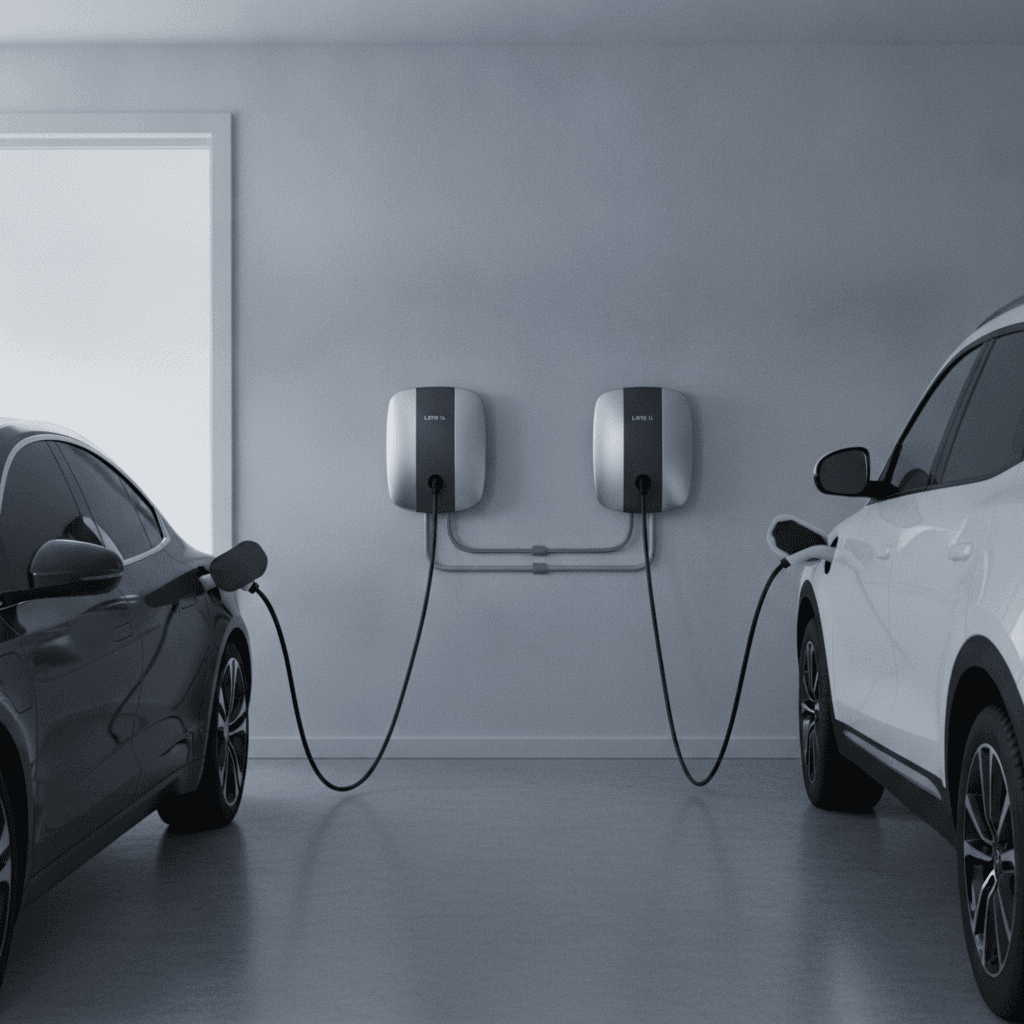
EV Charger for Two Cars: Two Circuits or Power Sharing?
Two EVs do not always need two full circuits. Compare Tesla, Wallbox, Emporia, ChargePoint and Grizzl-E's real power-sharing specs, cost, and code.
Charger Type
Quick answer: Two EVs do not automatically need two full 240V circuits. Start with daily miles and parking, then pick one of four real paths: one charger and a rotation habit, two independent circuits, one circuit with brand-specific power sharing, or a single dual-connector charger. The power-sharing hardware differs by brand and is not interchangeable: Tesla's Group Power Management links up to 6 Wall Connectors over WiFi, Wallbox's Power Sharing links up to 25 chargers over a wired CAN-bus cable, and Emporia's Intelligent Load Sharing links 2 or more Emporia chargers for free over the cloud, no extra hardware. ChargePoint's Home Flex does not power-share with another Home Flex today. Whichever path you pick, a licensed electrician still needs a load calculation before you buy the second circuit or the sharing hardware.
Best for
Two-EV households deciding between one charger, two chargers, or a load-sharing setup, including buyers who already own one brand of charger and are adding a second car.
Wrong fit
Apartment buildings, HOA-managed shared lots, or commercial fleet charging, covered separately in EV charging in a condo or HOA.
Tradeoff
One charger is cheaper and often enough. Two full circuits cost the most but need no coordination. Power-sharing hardware splits the difference, but only within one brand's ecosystem, not across brands.
Two EVs do not automatically mean two expensive charging circuits.
The right setup depends on miles, parking, and which brand's power-sharing actually works with what you own.
Quick Answer: The Four Real Paths
Setup
How it actually works
Best for
Real cost signal
One Level 2 charger, rotate
Whoever needs it more plugs in; the other tops up on Level 1 or waits
Daily Miles and Parking Matter More Than Battery Size
A big battery does not matter if the car only drives 30 miles a day. A smaller battery matters more if it arrives home nearly empty every night. Design around the energy you actually replace overnight, not the rare road-trip day. Public fast charging covers the exceptions.
If both cars have fixed, separate parking spots and both drive high daily miles, one charger and a rotation habit gets old fast. If either car can wait, or the household has flexible schedules, one charger goes further than most people assume.
Power Sharing Is Not One Feature, It Is Five Different Ones
This is the part that gets flattened into "some chargers support load sharing" everywhere else online, and it is where two-EV buyers get burned by mixing brands expecting one system to talk to another. Here is what each brand's power sharing actually is, as published by each manufacturer.
Brand
What it is called
How units connect
How many units
Minimum per vehicle
Extra hardware or cost
Tesla
Group Power Management
Wireless, unit-to-unit WiFi
Up to 6 Wall Connectors (1 leader, up to 5 followers)
Not separately published; power is split within the group's total
Firmware feature, no separate accessory
Wallbox
Power Sharing
Wired, a CAN-bus signal cable run between units alongside the power wiring
Up to 25 Pulsar or Commander units on one circuit
6A guaranteed per vehicle
The signal cable and its install labor; distinct from "Power Boost," which needs a separate Power Meter accessory for whole-home management
Emporia
Intelligent Load Sharing
Cloud-based, over WiFi, no extra wiring between units
2 or more Emporia Classic or Pro chargers
6A guaranteed per vehicle
Free, included, no subscription, no Vue monitor required
ChargePoint
None on Home Flex today
N/A
N/A
N/A
ChargePoint has announced a future series-wiring architecture for two-unit sharing, not yet shipping to residential buyers as of this writing
Grizzl-E
Built into the Duo, one physical unit
Two J1772 cables from a single 40A/9.6kW charger body
2 connectors on 1 unit, not 2 separate chargers
Not separately published
None; it is one charger, not a sharing system between two chargers
Verify current specs and firmware requirements at purchase, since these are software-defined features that manufacturers update. Sources are listed at the bottom of this page.
The buyer mistake this table exists to prevent: assuming any "smart" charger can share power with any other smart charger. It cannot. Tesla shares with Tesla, Wallbox shares with Wallbox, and Emporia shares with Emporia. If you already own one brand's charger and are adding a second car, that existing brand decides your sharing options, not the other way around. The connector question layers on top of this, especially for a mixed Tesla and non-Tesla household, covered in NACS vs J1772.
If you want the simplest single-brand setup
Both cars will be Tesla, or you are fine with a Tesla-only sharing setup: two Wall Connectors with Group Power Management is the most mature version of this, WiFi-coordinated with no extra wiring between units. See the Tesla brand page for current pricing.
You want a wired, no-WiFi-dependency sharing link: Wallbox's Power Sharing runs over a physical CAN-bus cable rather than WiFi, which some buyers prefer for reliability. It costs the extra cable run and labor, not a second full circuit. See the Wallbox brand page.
Your panel is tight and you want the cheapest sharing setup: Emporia's Intelligent Load Sharing is free with any two connected Emporia Classic or Pro chargers, no added hardware. It pairs naturally with the panel-avoidance case in do I need a panel upgrade for an EV charger. See the Emporia brand page. If you are still choosing between these two brands before the sharing question even applies, the full comparison, including Wallbox's current company status, is in Emporia vs Wallbox.
You want the flexible plug-in-or-hardwired, J1772-or-NACS pick: ChargePoint's Home Flex is a strong single-charger unit, covered in best home EV chargers, but as of this writing it does not power-share with a second Home Flex. Budget it as two independent circuits, or wait on ChargePoint's announced future architecture. See the ChargePoint brand page.
You want one box instead of a sharing system between two: the Grizzl-E Duo is a single 40A/9.6kW unit with two J1772 cables that dynamically shares its own output, UL tested and certified. It is not a system for sharing between two separate charger purchases, it is one charger built for two cars parked at the same wall. See the Grizzl-E brand page and the wider budget field in best budget EV chargers.
Why Power Sharing Is Legal to Install on a Smaller Circuit
A licensed electrician cannot just eyeball this. The 2023 National Electrical Code, Section 625.42(A), permits sizing a circuit or service to the maximum load an Energy Management System (EMS) is set to allow, rather than to the full nameplate demand of every connected charger added together, when that EMS is installed per NEC Article 750.30. In plain terms: if your EMS is set to cap two chargers at a combined 40A, your electrician can size the circuit for 40A instead of the roughly 96A that two full 48A chargers would otherwise demand on paper. The equipment doing the limiting also has to be listed for the purpose, not an improvised app schedule. This is the same code basis covered generally in EV charger load management, applied here to two-charger households specifically.
Ask any electrician quoting a two-EV job two direct questions: is the sharing system listed equipment, and is the circuit sized to the managed load or to both chargers' full nameplate rating. The answer changes the invoice.
Two Full Circuits: The Simple, More Expensive Path
If your panel has room and both cars need reliable, uncoordinated full-speed charging, two independent circuits skip all the brand-matching above. Each circuit is priced the same way a single charger install is priced: about $500 to $1,500 all-in with panel capacity and a short run, or $1,500 to $4,000 or more if either run is long, detached, or forces a panel or service upgrade. Running two circuits does not double a shared panel upgrade, since the upgrade (if needed) happens once, but it does mean paying for two full circuit runs instead of one plus a sharing cable or a free software feature. Price both scenarios honestly in the real cost of installing an EV charger before deciding sharing is worth the brand lock-in.
How to Pick in One Read
Moderate combined miles, flexible schedules? One charger, rotate. Skip the whole sharing question.
High miles, fixed spots, panel has room? Two independent circuits. No brand matching required.
Tight panel, both cars fixed at the same wall or nearby? Power sharing within one brand: Tesla for a WiFi-based setup, Wallbox for a wired link, or Emporia for the free, no-extra-hardware option.
Want one box instead of two purchases? A dual-connector single unit like the Grizzl-E Duo.
Whichever you pick, run the amperage math for your actual cars and miles in the EV charger amperage guide, confirm the panel can take it in do I need a panel upgrade for an EV charger, and have a licensed electrician run the load calculation before anyone buys hardware. The 240V circuit and any EMS install is licensed-electrician work, always.
Frequently Asked Questions
Do I need two chargers for two EVs?
Not always. One Level 2 charger works for many households when combined daily mileage is moderate and drivers can rotate who plugs in first. Two chargers, or a sharing setup, earn their cost when both cars need reliable overnight charging at fixed, separate spots.
Can two different brands of chargers share power with each other?
No. Every power-sharing system on the market today, Tesla's Group Power Management, Wallbox's Power Sharing, and Emporia's Intelligent Load Sharing, only coordinates between chargers of that same brand. A Tesla Wall Connector cannot power-share with a Wallbox Pulsar Plus. If you already own one brand and want sharing for a second car, buy the second charger from the same brand.
Does the ChargePoint Home Flex support power sharing with a second unit?
Not as of this writing. ChargePoint's current Home Flex has no charger-to-charger power-sharing feature; each unit is sized to its own circuit. ChargePoint has announced a future architecture that splits power across two units, but it had not shipped to residential buyers at the time this page was checked. Verify current availability before assuming it.
Is a dual-connector charger like the Grizzl-E Duo the same thing as power sharing between two chargers?
No, and this is a common mix-up. The Grizzl-E Duo is one physical charger with two cables that dynamically divides its own single output between two cars. Tesla, Wallbox, and Emporia's systems are software that coordinates between two or more separate charger purchases. Both approaches avoid a second full circuit, but they are different hardware.
Can two EV chargers share one circuit legally?
Yes, when the equipment doing the sharing is listed for the purpose and the install follows NEC 625.42(A) and Article 750.30, which lets a licensed electrician size the circuit to the managed load an Energy Management System allows rather than to both chargers' full nameplate demand. An improvised app schedule with no listed EMS behind it does not meet this bar.
Should I install for 48A per car if I am adding a second EV?
Usually not automatically. 48A per car is often more amperage than the household needs and raises the odds of a panel or service upgrade on a tight panel. Size each circuit, or the shared circuit's cap, to your actual cars' daily miles using the amperage guide before defaulting to the biggest number.
These guides are built from manufacturer documentation, public specifications, primary research where safety claims matter, and repeated buyer questions that show up in real ownership and installation decisions.
Manufacturer responses can clarify pricing bands, warranty terms, support footprint, or common mistakes. They do not move a page up the shortlist on their own.