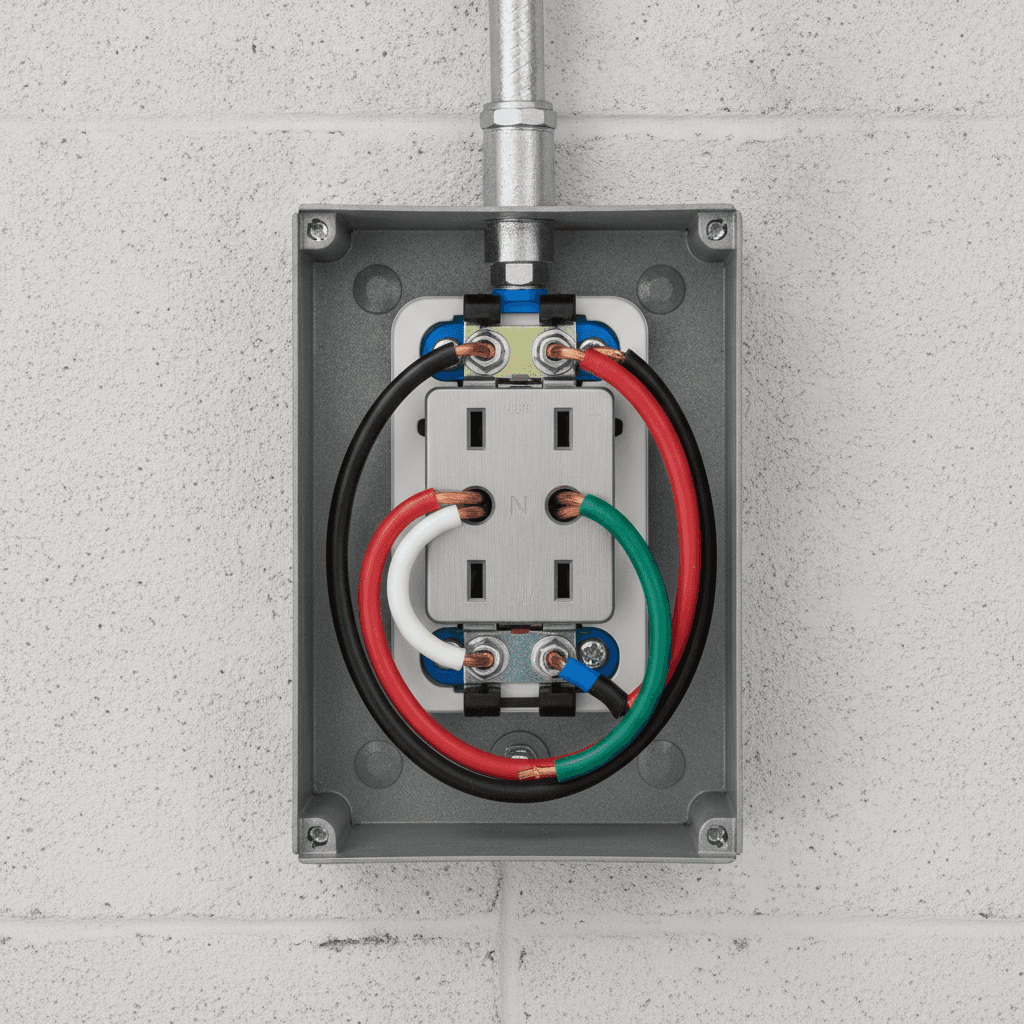
Cheap NEMA 14-50 outlets melt under continuous EV load. Why makers steer buyers to hardwiring or industrial receptacles, and what GFCI code requires.
Installation
Quick answer: A NEMA 14-50 outlet is safe for EV charging only if it is an industrial-grade receptacle, installed to code by a licensed electrician, on a GFCI-protected circuit with tight terminations. The cheap $10 to $15 residential 14-50 outlets rated for 60 degrees C are the ones that melt, because a car pulls near-maximum current for hours, not the few minutes a stove or dryer runs. That is why the 2020 and later National Electrical Code requires GFCI protection on any receptacle used for EV charging (NEC 625.54), and why Tesla and others now recommend hardwiring the charger instead. If you go plug-in, use an industrial 14-50 such as a Hubbell or Bryant rated for 75 degrees C, not the big-box unit.
Best for
Anyone choosing a plug-in EV charger who wants to know whether a 14-50 outlet is safe, and how to make it safe.
Wrong fit
Buyers who only want product picks. This page has none. It is safety information, served straight.
Tradeoff
A plug-in 14-50 is flexible and swappable, but it adds a connection that can melt if it is cheap or loose. Hardwiring removes that failure point at the cost of flexibility.
A NEMA 14-50 outlet can be a safe way to charge an EV, and it can also be the exact part that melts, arcs, and starts to smoke. The difference is not luck. It is whether the outlet is an industrial-grade receptacle installed to code with tight connections, or a $10 receptacle from a big-box shelf wired in a hurry.
The core problem is continuous load. A stove or a welder pulls hard for a few minutes at a time. A car pulls near its full current for hours, night after night. Cheap 14-50 outlets are built for the first job, not the second, and the failures show up as blackened terminals, deformed plastic, and in the worst cases, fire. This page explains why, and how to do it safely. It has nothing to sell you.
Quick Answer: Cheap Outlet vs Industrial vs Hardwire
Option
Safe for continuous EV load?
$10 to $15 residential 14-50 (60 degrees C)
No, this is the one that melts
Industrial-grade 14-50 (Hubbell, Bryant, 75 degrees C)
Yes, installed to code with GFCI
Hardwired charger, no outlet
Yes, and it removes the failure point entirely
If you take one thing from this page: the receptacle is not where you save money. A proper 14-50 install with an industrial receptacle and a GFCI-protected circuit runs several hundred dollars in parts and labor, and that is the price of it not melting.
Why Cheap 14-50 Outlets Melt Under EV Load
Two things combine. First, the load is continuous, so heat builds and never gets a break. Second, a cheap receptacle uses thin brass contacts, a lower-temperature body rated to 60 degrees C, and looser clamping on the wire. Under a car pulling 40 amps for six hours, any resistance at a contact point turns into heat, the plastic softens, the contact loosens further, and the resistance climbs. That is a runaway loop that ends in a melted plug and a charred receptacle.
Owner forums are full of these photos, and the pattern is consistent: an inexpensive outlet, sometimes a slightly loose terminal, and a connector that melted after weeks or months of nightly charging. It is not a freak event. It is the predictable result of asking a $10 part to do a job it was never built for.
Industrial-Grade Is a Different Part
An industrial 14-50, such as a Hubbell HBL9450A or a Bryant 9450FR, is built for this. It uses a reinforced thermoset body rated to 75 degrees C instead of 60, heavier brass contacts, and a more robust wire clamp. It costs around $50 to $80 instead of $10, and that gap is the entire safety margin. If you are going plug-in, this is not the place to save $60. Ask the electrician to install an industrial-grade receptacle by name, and confirm it on the invoice.
GFCI Is Required, and It Catches the Early Failure
Since the 2020 edition, the National Electrical Code requires GFCI protection on any receptacle installed for EV charging (NEC 625.54), on top of the existing garage requirement for 125 to 250 volt receptacles (NEC 210.8). Ground fault protection trips when current starts leaking to ground, which is an early signature of a failing connection or damaged insulation. On a plug-in charger that protection is provided by a listed two-pole GFCI breaker. It is a real safety layer, and where your jurisdiction has adopted the 2020 or later code, it is not optional.
One honest caveat: many Level 2 chargers already include their own internal ground fault protection, and stacking a GFCI breaker on top can cause nuisance trips. That is annoying, not dangerous, and it is one of the reasons the industry has moved toward hardwiring at higher amperage.
Why Manufacturers Now Steer You to Hardwiring
Tesla no longer recommends installing a new NEMA 14-50 outlet to charge a car, and points buyers to hardwiring the Wall Connector instead. The logic is simple. A hardwired connection has no plug and no receptacle, so there is no contact to loosen, wear, or melt, and no dependence on whoever chose the outlet. It also allows higher amperage, up to 48 amps, where a plug-in unit is typically capped lower. The tradeoff is flexibility: a hardwired charger cannot be unplugged and taken with you. The full comparison, including cost, is on hardwired vs plug-in EV charger.
Loose Terminations Are the Hidden Cause
Even a good outlet fails if the wire is not clamped tight to spec. A terminal that is slightly loose leaves a high-resistance point, and under continuous load that point heats up until it fails. This is why the install is a licensed electrician's job, torqued to the manufacturer's specification and checked at inspection, not a weekend project with a screwdriver. Our EV charger safety guide covers the wider picture of wire sizing, breakers, and connections, and do I need a permit to install an EV charger explains why the inspection matters.
The Practical Call
If a proper 240V outlet already exists and was installed to code, a plug-in charger on an industrial 14-50 is a reasonable, safe choice. If you are installing the circuit from scratch and running the charger at 40 amps or more, hardwiring is the more conservative option and often the one the manufacturer recommends. Neither one is the cheap-outlet-on-a-shelf version. That is the version that melts, and it is the one to refuse.
Frequently Asked Questions
Is a NEMA 14-50 outlet safe for EV charging?
Yes, if it is an industrial-grade receptacle installed to code by a licensed electrician on a GFCI-protected circuit with tight connections. It is not safe if it is a cheap $10 to $15 residential outlet, which can melt under the continuous, hours-long load an EV puts on it. The outlet is the part people try to save money on, and it is the part that fails.
Why did my 14-50 outlet melt when I charge my car?
Almost always because the outlet was an inexpensive residential unit, a terminal was slightly loose, or both. A car draws near its full current for hours, and any resistance at a contact point turns into heat that builds with nowhere to go. The plastic softens, the contact loosens, and the failure accelerates. An industrial-grade receptacle with properly torqued connections is built to handle that load.
Should I hardwire my charger or use a 14-50 outlet?
If you are running 40 amps or more, or installing the circuit new, hardwiring is the more conservative choice because it removes the receptacle, which is the failure point. A plug-in 14-50 makes sense when a proper industrial outlet already exists and you value being able to unplug the charger. Tesla and several others now recommend hardwiring for exactly the safety reason.
What is the difference between a $15 and a $60 NEMA 14-50 outlet?
The expensive one is an industrial-grade receptacle, such as a Hubbell or Bryant, with a body rated to 75 degrees C, heavier brass contacts, and a stronger wire clamp. The cheap one is rated to 60 degrees C with thinner contacts. Under continuous EV charging, that difference is the entire safety margin, which is why it is a bad place to save money.
Do I need a GFCI breaker for a 14-50 outlet used for charging?
Yes, where your jurisdiction has adopted the 2020 or later National Electrical Code. NEC 625.54 requires GFCI protection on any receptacle installed for EV charging, and NEC 210.8 requires it for 125 to 250 volt receptacles in a garage. It is usually provided by a listed two-pole GFCI breaker. Your electrician and local inspector confirm what your adopted code year requires.
Can I install the 14-50 outlet myself to save money?
No, and we never coach 240 volt do-it-yourself wiring. A 14-50 for EV charging is a high-current circuit that needs correct wire sizing, GFCI protection, torqued terminations, and a permitted inspection, and a small error becomes a fire risk that runs every night. Understanding the work so you can budget it and question a quote is smart. Running the circuit yourself is not.
Methodology
These guides are built from manufacturer documentation, public specifications, primary research where safety claims matter, and repeated buyer questions that show up in real ownership and installation decisions.
Manufacturer responses can clarify pricing bands, warranty terms, support footprint, or common mistakes. They do not move a page up the shortlist on their own.